Why these pages are separate from the application
The admissions page is how a family starts: the form, the motto, who may apply, and the partnership the school expects. This page is the constitution of daily authority. It says who runs the school, who teaches, who may enrol, how the money works, and how the school draws itself. Families should read it before they treat a place as accepted. The wording below follows the school’s own policy statements.
Corporate colours
Turquoise blue, grey, and white. They are on the crest, on the blazer uniform, and on the buildings around the courtyard. They are not a decoration added by the website. When the school talks about identity, these are the colours it names.
Objectives
At Harmony Pre and Junior School, the commitment is to provide the highest quality of education. The aims and objectives are to:
- encourage learners’ need for exploration by stimulating their natural love of learning in a more excellent way;
- maximise each learner’s individual potential;
- prepare learners to become independent, responsible individuals by instilling the fundamental skills of learning;
- allow learners to experience the excitement of learning by freedom of choice.
The school will endeavour to produce high standards, with a view to future leaders who will live their lives in a more excellent way. That last line is the one the school attaches to its organogram. Leadership, in this document, is the point of the structure, not a prize at the end of a concert.
School administration
The school administration shall consist of the School Administrator, the Principal, and any other two members appointed by the shareholder. That is a small administration by design: named offices, plus two people the shareholder appoints. It is not a large committee described in vague terms. Questions of fees, admission, transport, and the day-to-day exceptions — a missed bus, a Friday uniform question, a letter about food — go to this administration, at the administration building.
Parents do not appoint those two members. The shareholder does. Parents’ share of the school is the partnership already described: attendance, punctuality, understanding of policy, and the payment of fees and levies before the term.
The teachers
The school uses private and highly qualified teachers. They are selected on past experience, qualifications, the ability to fit the goals of the school as modelled by the shareholders, and moral values. A qualification on paper is not the only test. The school also asks whether the person can work inside the goals the shareholders have set, and whether their moral values fit the school.
The School Principal, on the recommendation of or in consultation with the Chairman of the board of directors, interviews suitable candidates. Candidates are drawn from a shortlist compiled by the shareholders, the chairperson of the board of directors, or any proxy of the chairperson. Teaching appointments are therefore a board-level act, not a notice pinned in a staff room. The stated student–teacher ratio of the school is 1:20.
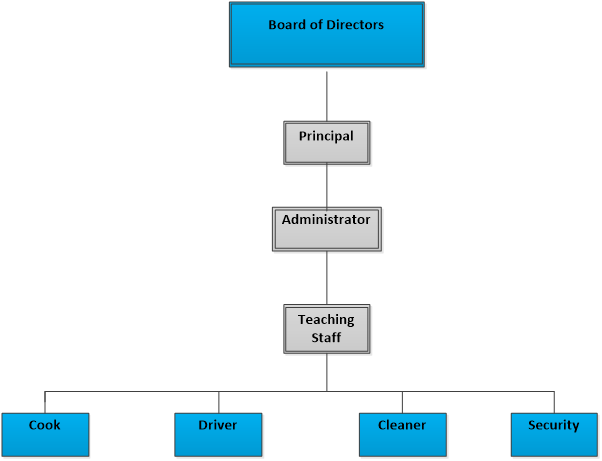
School organogram
The organogram is the picture of that authority. It is published below so families can see the lines, not only read the sentences. The school’s accompanying text is that it will endeavour to produce high standards, with a view to future leaders who live in a more excellent way.
Eligibility for enrolment
All Zimbabwean and non-Zimbabwean kindergarten school-age children who meet the academic selection criteria are eligible to enrol. Nationality is not a bar. Age, for this policy, is kindergarten school age, inside a pre and junior school. The academic selection criteria are the school’s to apply.
No student will be discriminated against on the basis of sex, race, creed, infirmity, or the political persuasion of parents. Infirmity is named on purpose. A child’s health or disability is not, by this policy, a reason for refusal. Political persuasion of the parents is not a reason for refusal. Sex, race, and creed are not reasons for refusal. The criterion that remains is the academic one, together with the family’s acceptance of the terms.
Financing
School programmes are financed by fees and levies received from parents of the learners, and by donations from well-wishers and stakeholders. Fees and levies are paid before the commencement of each term. Disbursement of the money within the school is determined by an annual budget approved by the Executive Board.
Two payment paths are published. Option A is cash or swipe at the Harmony cashier’s office. Option B is a bank transfer, after which the proof of payment is submitted or emailed to [email protected]. The current structure of amounts is not printed here. It is requested from the office, as the fees page explains. Donations do not take the place of a family’s fees.
Gender balance
The gender distribution of learners and of staff members shall be balanced as much as possible. The policy is an aim the school holds while it enrols and while it appoints. It is not a published numerical quota. A class of a given year will reflect the children who applied and who met the academic criteria, held as near a balance as the school can manage.
Parent involvement, restated
Parents and families are essential partners, and their involvement is highly cherished. The involvement the school cherishes is specific. It is attendance. It is punctuality, which at this school means a child who is here for a 7:00 gate and an 8:00 bell, and who is collected at 3:30 or placed correctly on the bus. It is an understanding of policies and procedures: uniform, fees before term, named belongings, the bus route if you use it, and the authority of the administrator and the principal.
The school is at 31949, Mabvazuva, Ruwa, Harare. Write to [email protected] or call 077 690 8490.